There’s a particular expression I’ve seen on the faces of so many women in engineering: a sort of tight, polite smile that says: “I know exactly what I’m doing, but I’m also one minor comment away from rethinking my entire career.”
Technical credibility is strange that way. Men often get it by default. Women feel like we have to earn it, defend it, protect it, and continually re‑prove it… sometimes daily.
And here’s the kicker: the more we try to “prove we belong,” the more we drift toward burnout. We over‑prepare. We over‑deliver. We take on more than our share. We become the “excellent woman” . The one who’s brilliant, dependable, capable, and absolutely exhausted.
So let’s talk honestly about what technical credibility really is, what it isn’t, and how to build it without lighting yourself on fire to keep the team warm.
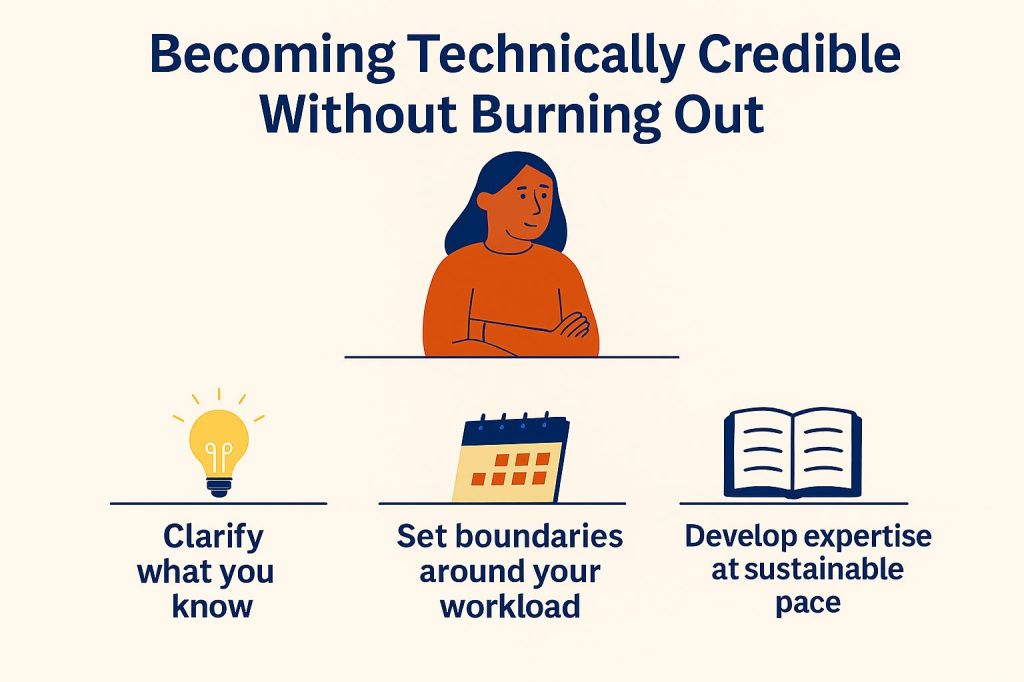
The Myth: Technical Credibility Is About Knowing Everything
So many women quietly believe that the only way to be taken seriously technically is to be impossibly prepared at all times:
✅never be wrong.
✅never say “I don’t know.”
✅anticipate every question.
✅double‑ and triple‑check every calculation.
✅become the unofficial expert on everything within a 10‑metre radius of your workstation.
But here’s the truth that nobody bothers to tell women:
Technical credibility is not the same thing as technical perfection.
When men build credibility, it’s generally through:
- consistency
- visibility
- confidence
- being willing to try, learn, adjust, and move on
It’s not because they scored 100% on every exam, or because they memorised every spec sheet in existence. It’s because they show up like someone who belongs in the room.
Meanwhile, women often treat credibility like a fragile object: one mistake away from shattering.
You are allowed to not know things. Allowed to learn out loud. And you are definitely allowed to grow on the job, the same way everyone else does.
The secret is this: credibility comes from trust, not omniscience.
It has been years since I knew more than my team about everything. But when they take the time to explain things, in single syllable words, I can usually pick up the jist. And when you’re explaining things to senior management – most of the time they know less than you. They need to trust that you understand enough to support the decision. That’s it.
The “Prove Yourself Twice as Hard” Trap
If you’re a woman in engineering, you’ve probably lived this moment:
You deliver a piece of work at 110%, and someone says,
“Oh, great, thanks. Could you also take care of…?”
➡️You take on the extra task.
➡️You nail it.
➡️Someone else hands you another.
➡️And another.
➡️And another.
Without realising it, you’ve become the team’s catch-all, rescue resource, and quiet technical backbone, all while your peers are working comfortably at 70%.
This trap works in three steps:
- You feel underestimated, so you work harder.
- Your hard work becomes invisible, because it looks effortless.
- Your effort becomes expected, so the bar moves again.
By the time you realise what’s happening, you’re the “excellent woman”: competent, reliable, and drowning.
And the worst part?
You start thinking this is what credibility requires.
But it doesn’t.
Overperformance is not a strategy.
It is a burden.
And it teaches people to give you more work, not more respect.
What Technical Credibility Actually Looks Like
Let’s rewrite the definition in a way that works for women — sustainably.
1. Credibility is built through clarity, not volume
Being the person who can explain complex things simply is far more valuable than being the person who over‑explains to prove you understand.
2. Credibility grows when you make good decisions, not when you do everything
Strong prioritisation is a technical skill.
Boundary-setting is a technical skill.
Saying “that’s not the critical issue here” is a technical skill.
3. Credibility is reinforced by consistency
You don’t need brilliance every day.
You need steadiness.
Professionals remember reliability far more than moments of genius.
4. Credibility deepens with collaboration
Women often think asking questions undermines our expertise.
In reality, asking the right questions demonstrates sharp engineering thinking.
5. Credibility shines when you document well
Notes, logs, designs, decisions — clear documentation is an engineering superpower, not secretarial work. It makes future-you (and your team) better.
Not one of these requires burnout.
Not one requires perfection.
And most definitely, not one requires martyrdom.
Building Expertise Sustainably
You don’t have to master everything at once. Technical growth happens in cycles – exposure, confusion, understanding, mastery – repeated endlessly.
Here’s what sustainable expertise actually looks like:
Choose depth strategically
Pick one or two areas that genuinely interest you and go deep.
Nobody respects the engineer who tries to be an expert in all things.
Learn in public, safely
Say things like:
- “Here’s my current understanding…”
- “Let me sanity-check this…”
- “I’m still learning this component, but here’s what I see so far.”
It signals competence and growth mindset.
Build a technical network
Find the people who know the things you don’t.
Trade knowledge.
Ask, offer, exchange… Credibility flows through relationships as much as through expertise.
Treat learning time as legitimate work
It’s not “extra.”
It’s part of your job.
Emerging technology doesn’t stay still. why should your knowledge?
Protect recovery time
Your brain cannot do complex problem‑solving if it’s running at 2% battery.
Rest is not a luxury; it’s an engineering requirement.
You Don’t Need to Earn Your Place Twice
We’ve all felt it. You walk into a new team, new meeting, new workplace, and suddenly you have to start from scratch again, showing what you know. Proving yourself, over and over again. Having junior engineers (or more junior to you at least!) “test” your knowledge in ways they never test male counterparts.
And it’s so tempting to respond and put them in their place. But that takes time and energy. Remember:
You’re already an engineer.
Your qualifications are real.
Your contributions matter.
Your expertise is valid — even if it’s still developing, even if you’re still growing, even if you don’t have every answer right now.
Credibility doesn’t come from punishing yourself into excellence.
It comes from doing the work steadily, visibly, sustainably, and with enough confidence to let learning be part of your identity rather than a threat to it.
You’re not here to prove yourself.
You’re here to be yourself — as an engineer.
And that is more than enough.

 EngineerHer
Leave a comment