I’ve been writing about leadership, and confidence and microaggressions over the past few weeks. One of the (less-subtle) themes that readers repeatedly raised with me afterwards was the constant expectation that women will take on what’s often called “office housework.”
Never heard of this term? Lucky you! These are the tasks that are vital to team functioning but rarely recognised, celebrated, or considered when promotions come around. And yet, despite their importance, somehow they seem to find their way to the same people again and again. And it’s usually women.
Office housework isn’t the glamorous kind of work that shows up in performance metrics or project dashboards. It’s the quiet, behind-the-scenes labour: organising the meeting, taking the minutes, keeping the team calendar updated, picking up the loose ends no one else wants to touch. It’s organising birthday cards and celebration cakes. Booking the venue for the team lunch.
Any of this sounding familiar?
Engineering should be a discipline where technical contribution and problem-solving define your reputation. Yet too many women find themselves being subtly funnelled into support roles they never asked for. The impact isn’t benign. It affects visibility, perceived competence, and ultimately, career progression.
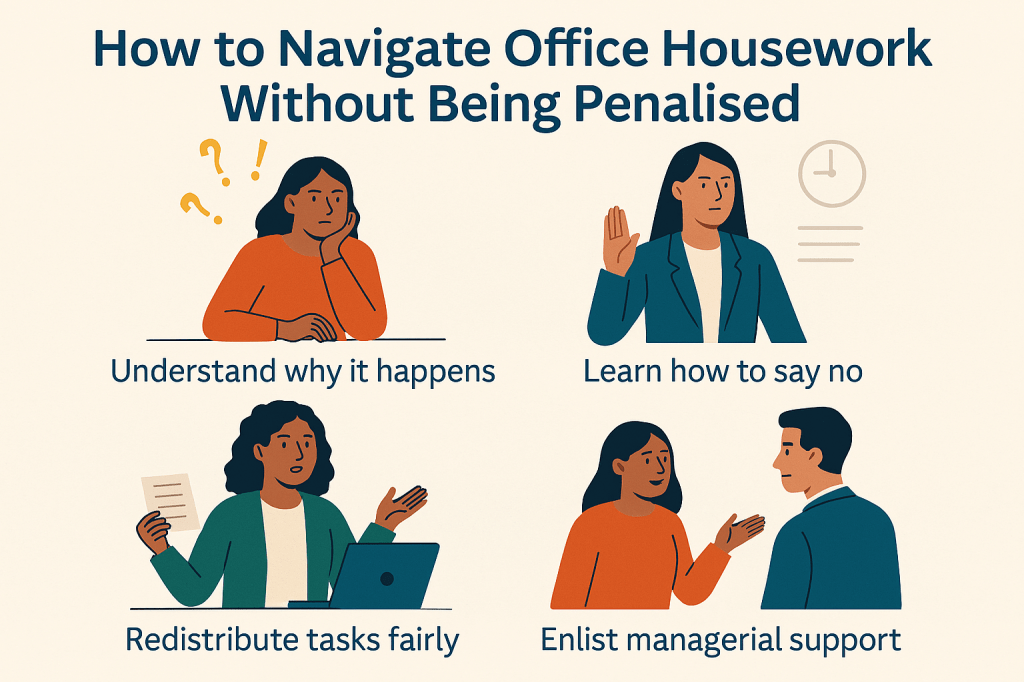
Why Office Housework Falls on Women
It’s patriarchy, d’oh.
OK, on a more serious note.
There are deep cultural patterns behind this. Many of us grew up being praised for being helpful, organised, and thoughtful. You know, traits that absolutely have value but become limiting when they turn into workplace expectations. In engineering, women are still too often viewed as the natural communicators, the natural organisers, the ones who will “keep things tidy” while the men get on with the technical work. Even when no one says these assumptions out loud, they linger in subtle decisions: who’s asked to take notes, who’s nudged to plan the celebration, who gets the “can you just…” tasks that pile up into real time sinks.
There’s also the uncomfortable reality that declining these tasks can feel risky. Men who protect their time are seen as focused. Women who do the same are often judged as difficult or uncooperative. It’s no wonder so many women say yes automatically. It feels easier than managing the fallout of saying no. But constantly saying yes slowly anchors you in a role you never chose.
But yeah. It’s patriarchy holding us to these tasks and it’s patriarchy then saying these tasks have less value.
How to Decline Without Backlash
The good news is that declining doesn’t have to be dramatic or confrontational. In fact, the most effective ways to say no are calm, neutral, and matter-of-fact. Instead of apologising or offering elaborate explanations, it can be as simple as clarifying your priorities: “I’m focused on delivering the technical work for this project right now, so I can’t take that on.” Stated plainly, it positions your time as valuable. Which it is.
Another helpful approach is to redirect the task back to the group rather than absorbing it yourself. Something like “I’m at capacity with my project work. Who else has bandwidth for this?” gently reinforces that the responsibility doesn’t automatically fall to you.
You can also set boundaries by agreeing once but making it clear it won’t become a pattern: “I can do it today, but let’s rotate this going forward.”
These small shifts signal that your technical contributions take precedence, without creating unnecessary tension.
Redistributing Work Fairly – Without the Emotional Labour
Of course, sometimes these tasks genuinely need to get done, and the answer isn’t simply refusing but redistributing them more equitably. One practical and low-conflict solution is to formalise a rotation system. Once tasks like note-taking or meeting logistics are shared according to a schedule, there’s no room for assumptions; it becomes routine rather than personal.
Another subtle but effective strategy is to highlight the trade-off inherent in taking on administrative tasks. For example, if you’re leading the technical delivery of a project, you can say, “If I handle the minutes, I’ll have to push some of the technical work to later. Who else can take this so we stay on track?” Suddenly, the impact is obvious, and people reconsider before automatically turning to you.
Sometimes the best way to avoid being saddled with housework is to improve the process itself. Offering to streamline or automate certain administrative tasks shows leadership while reducing everyone’s workload. It allows you to contribute without getting stuck as the default organiser.
What Managers Need to Understand, and More Importantly Fix
While individual strategies help, the deeper solution lies with managers who are willing to acknowledge and correct invisible labour loads. Good managers actively track who is doing what, not just in terms of technical output but in terms of unseen contributions that keep the team moving. When managers realise that the same people are consistently picking up admin or relational tasks, they can intervene early and redistribute.
Another key responsibility is making these tasks explicit rather than relying on volunteers. When a manager says, “We need someone to take notes,” women often interpret that as a polite request directed at them. Men don’t. (as a general rule, obviously) But when a manager assigns tasks clearly and rotates them intentionally, the burden shifts in a way that supports fairness.
Finally, managers must recognise that relational labour, such as mentoring, supporting, smoothing conflicts, is real work that deserves acknowledgement. It shouldn’t be assumed or taken for granted simply because certain people are good at it. When those contributions are recognised in performance reviews and built into development plans, they stop being invisible and start being valued.
Your Time and Expertise Are Not Disposable
At the end of the day, office housework becomes a barrier when it distracts you from the work that actually builds your engineering career. You deserve to spend your time on tasks that grow your skills, raise your visibility, and bolster your credibility, not on the endless stream of low-recognition chores that quietly pile up around women.
You are an engineer.
Your work has impact.
Your time is valuable.
And you have every right to protect it.


 EngineerHer
Leave a comment