I have a quote-a-day calendar for my desk at work and my quote for today is from Ernest Hemingway.
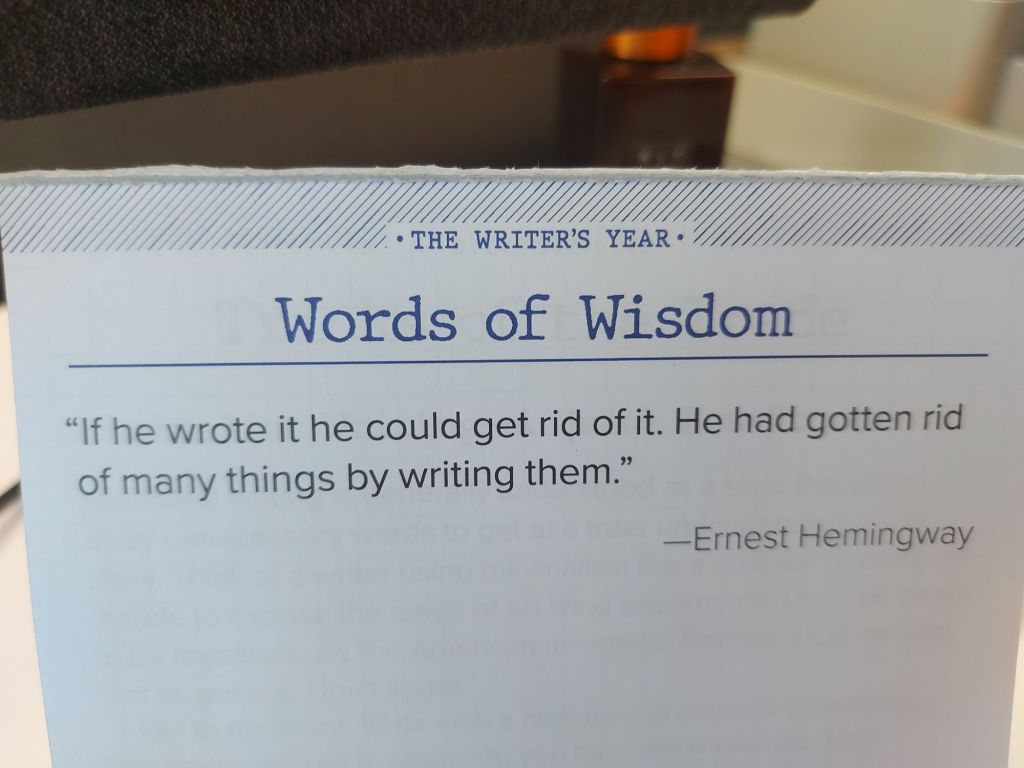
The quote comes from a short story by Hemingway, called “Fathers and Sons”, and you can read it in full here if you wish. However, I think the following words in the story are equally as important:
If he wrote it he could get rid of it. He had gotten rid of many things by writing them. But it was still too early for that. There were still too many people. So he decided to think of something else. There was nothing to do about his father and he had thought it all through many times.
Why do I think it’s important? Well, here we go. Last week I was talking about the Sunday Scaries. The week before, it was Leaving work at work. Both of these things can be helped by writing things down. So let’s explore further!!
Writing it down…
Journaling or keeping a diary is a long tradition with people in general. Any by long, I really mean in the last 5 or 6 centuries, because that’s when paper and pens and literacy started to become available to less rich people. (I may be off by a few centuries here, but it’s an indication only, ok?)
But why do people do it? Well, first and foremost, it helps you get to know yourself. There is something about writing down your thoughts and feelings that make it clear what’s going on with you and in your head. Now, I know there are people out there who don’t understand how anyone could not know what’s going on in their own head. But honestly, it’s really easy.
Particularly if you come from a traumatic, difficult, awkward background. Or even just a background where you just didn’t fit in. Situations like this can lead to you compartmentalising parts of your life, or suppressing feelings, emotions, experiences, memories… It’s not always in cases of trauma either. It can be what you do to keep going in a difficult situation.
So, writing things down, particularly in a free form context can help get your head clear. And this leads to my second point.
The right time
Hemingway’s third sentence in the quote above is really important. “But it was still too early for that.”
If you’re in the middle of survival mode, you might agree that journaling or keeping a diary would be helpful, but in reality, putting one foot in front of the other is about all you can do. So, we need to be practical here.
Writing takes time. It requires resources. It takes paper, pen, ink. Usually a flat surface, although with Bic pens, it’s possible to write at any angle that isn’t upside down. And even then, you’ll get a few letters scribbled out!
But, writing like this, writing to get your head straight, needs a headspace that will allow this to happen. And sometimes, it needs a bit of time and distance from the original event. This is a balance ok – if you leave it too long, there’s a whole load of knock-on effects that you will need to write out as well. Do it too quickly, and it may be less effective. Or you may not be able to form thoughts coherently. Or even write legibly about it. I have journal entries like this – I was scribbling so hard and fast that my already-bad handwriting was essentially a spider crawling in ink…
There is value in this type of writing as well, no doubt. But revisiting after some time will add clarity and support to your writing.
What to write about?
Honestly, if you’re building a regular writing practice – and I highly recommend it on mental health grounds, just for general life – you will get into the habit of letting your words just flow through you into the pen. I know – it sounds very airy fairy. But it is real. There are studies on writing and it’s effect on mental health.
Writing about trauma or stress has been shown to improve health and reduce stress, but can negatively affect mood.
– Pizarro, J. (2004). The Efficacy of Art and Writing Therapy: Increasing Positive Mental Health Outcomes and Participant Retention After Exposure to Traumatic Experience. Art Therapy, 21(1), 5–12. https://doi.org/10.1080/07421656.2004.10129327
Do note the caution there about writing improving health, reducing stress, but can have a negative effect on mood. The difference here is that mood is generally considered a short term thing, whereas health is more a medium- to long-term thing.
So, a heads up, that writing about difficult things may not improve your mood. But it will help health longer term.
Starting with a blank page is really difficult. Just think when you have to write up a report in work or a new document… the easiest thing to do is to get something else that’s similar and edit it. The blank page is just… scary.
Thankfully, there are wonderful people on the internet who give away journal prompts for free. Here’s a few sites I have found useful for this sort of thing:
Offline | Journaling Prompts For Conflict at Work
20 Journal Prompts for Tough Times | by Kirsten Alexis | Medium
120 Helpful Journal Prompts For Dealing With Difficult People To Empow – The Fifth Element Life
But as soon as you google “journal prompts for dealing with difficult times at work”, you will get loads of options. And having a question to answer will help you get started at least.
How to write
One of the hardest things to do here is not to self-edit. Seriously, even when writing in our private notebooks, we have a tendency to write what we think other people will understand, instead of writing what we really feel. This is a private space for you to let things spill out. These words won’t be seen by anyone else and therefore, won’t be hurting anyone else.
If there’s a really difficult entry you’ve written, where you feel worried about the thought of someone seeing it – burn it. You’ve gotten the words out, and the emotions that go with them, and then you burn them. It’s a powerful way of dealing with difficult situations. Or at least, reducing the emotion levels for these situations.
I describe it as switching off my brain and letting the words flow. Although I understand from a practical point of view, this isn’t that helpful. Here’s what I mean: letting your conscious, politically-correct, professional mind get out of the way and letting your true thoughts and feelings spill out. Remember, this isn’t going to be something anyone else ever sees. This is just for you.
So spill it all out. Write so fast your hand cramps – then write some more. ( I appreciate this is ableist here. For those who can’t write, there may be value in recording voice, but the effects, from the literature I’ve read, appear to be less) If you can’t think of anything to write, keep writing “I can’t think of anything to write!” until the words come again. And they will come again.
Set a timer for yourself. Give yourself a good ten minutes at least to start with. Because trust me – half the time, at least, will be spent twiddling your thumbs and wondering how you can put messy ink on this new, clean, blank page the first time. And possibly, the second time, the third time, but eventually, the words will come. And use an old notebook. This shouldn’t be a special notebook. This is a working notebook. This could be a random scrap of paper. This isn’t going to be a family heirloom, not words for the ages. This is for you and only for you.
Now, there’s nothing wrong with having a lovely, pretty, fancy notebook of some kind. I’ve done this myself. But what happens then, with me anyway, is that I think I can’t possibly mess it up and it needs to be kept for some special occasion…
What special occasion I think I’d be using a notebook for, I don’t know, but here we go.
Give it a go
Writing down words clears some space in your brain. It gives thoughts form and function and matter. It makes them real, so they don’t keep swirling in your head and cluttering up the place.
Write it out, get it out of the head and onto the paper. And if need be – burn it afterwards. That will make sure no one else will ever read it!

 EngineerHer
Leave a comment