Now, we all know that those of us in large organisations will not see the organisational goals until at least February, if not March in some cases. But that’s no reason to skip out on using the New Year energy to start outlining your own goals before they arrive. You will have ideas on what needs to be a goal for you this year in work. So why not get ahead of the curve.
But here’s the thing. Very often, when it comes to work in particular, we use projects instead of goals to do this. Projects are always able to fit into the traditional SMART framework, and they can be easy to list as goals. But there are some vital differences, two I consider to be most important of all!

Comfort vs Discomfort
This is that whole thing about being in your comfort zone and being just outside it…
Here’s the thing. There are four real zones of learning. The comfort zone, the fear zone, the learning zone and the growth zone. The picture below shows some of the concepts here and there’s a great article on Psychology today to discuss the concepts here.
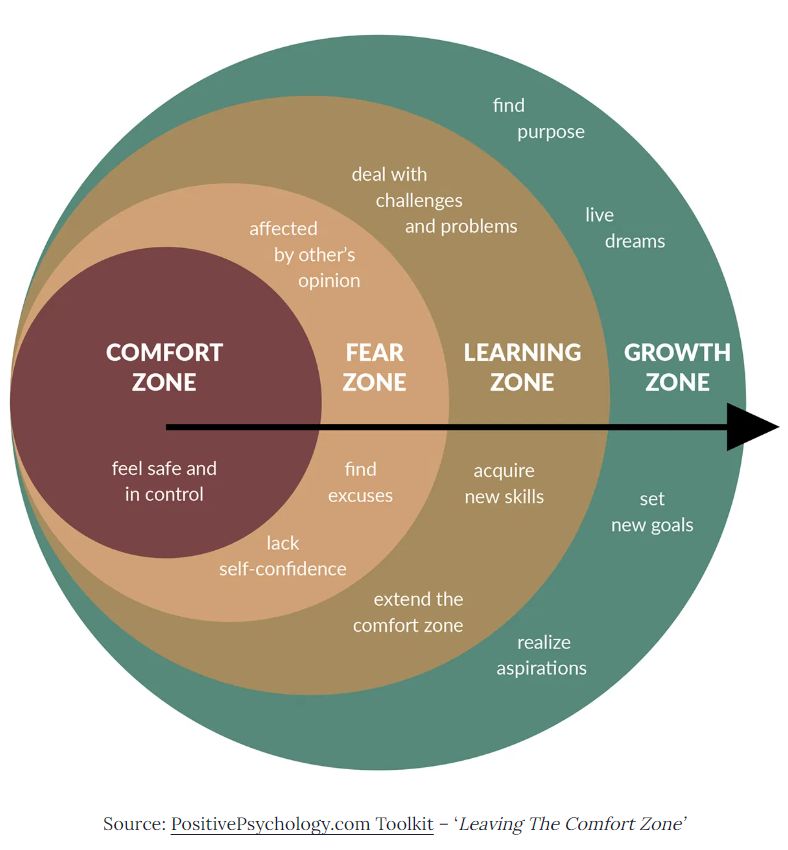
- The comfort zone is where we feel safe and in control. Anything the job, or indeed life, throws at us, we can handle here. This is safe, comfortable, easy to navigate. Essentially, you can navigate this zone in your sleep. Which is fun for a while, but might prove a bit boring after a bit…
- The fear zone is where we lack self confidence, depend a bit too much on other people’s opinions, may find excuses not to do things and general… don’t learn too much. It can be terrifying working in this zone! And if this is the place you’re in right now, please reach out. Maybe not to me, but to someone. There is help out there for you! But this can be a necessary step for some of us in the learning cycle.
- The learning zone Is where you’re picking up new skills. This is a means to expand your comfort zone as well. Your confidence is growing and things are starting to feel more natural. Well, less unnatural anyway. This can feel like a ramp, or an uphill journey, but unlike the fear zone, you’re gaining things along the way and you can see yourself improving.
- The growth zone is where some self-actualisation can occur and you’re really confirming these new growth areas as a new comfort zone now. (Sorry, did I forget to mention this? Your comfort zone will keep expanding as you work through this cycle.) You can set new goals, achieve targets, basically live your dreams… and then develop new ones!!
All this to say that if the work you’re imagining will happen right inside your comfort zone, this probably isn’t a goal. It’s a project at best, and might even be part of your day to day work. If you are 100% confident that this work will be completed well within the time frame… well either you don’t fully understand it or you are operating well within your comfort zone.
A bit of discomfort with a goal will lead to more excitement with it and a more likely chance you will actually accomplish it.
Which leads me to the next point.
Excitement versus banality
Excitement. Now, I’ll a lot of my thinking around goals versus projects comes from Michael Hyatt‘s work on the subject. Basically, he uses a SMARTER framework, that adds in excitement and risky to the traditional specific, measurable, achievable, relevant and time bound. Plus he changes achievable to actionable.
Risky, we covered in the last section – and I bet you didn’t even realise it! This section, we’re going to talk about excitement. Honestly, I know, we all get organisational goals that repeat year and year, and it’s almost like a pure copy and paste job for your goals tracker in the company software. Or the Excel sheet, depending on how big the organisation is.
I know on my list of goals there will be the following:
- stick to the budget
- meeting the operating plan
- no EHS incidents
- no major or critical quality incidents
- pass the audits, no matter what the audit is
- keep on top of training
Now, maybe for some people, that list incites excitement. It really doesn’t for me. These items for me are just part of the day-to-day. They’re not goals. They don’t excite me.
Now, I will say, in the past some of these goals have excited me. When I was working on a site that started off with major health and safety incidents on a regular basis, getting to zero was seriously exciting and was definitely a goal. I work in a much safer environment now, though, so it’s just day-to-day.
So, what does excite me? Here are some of my goals this year:
- Get accepted onto the part time doctoral program in UL
- Run my first group coaching program for women in engineering (if you’re interested, get in touch!)
- Implement the longer term project to be a gold standard for calibration within my organisation
- Finish my book (nothing to do with engineering this one!)
There are a few others around walking without pain, saving money, that sort of thing, but you get the jist. These items are exciting for me! These are things I want to get stuck into. These are things I have been thinking about for a long time and I’ve pulled the switch and am going to move forward on them.
You’ll also notice there are very few of them that are work related. In fact one with a possible second are work related.
That’s right, goals are just for work…
Transformation vs more of the same
Yes, this is a big one. For me (and yes, this comes from Michael Hyatt again) Your goals should lead to a change in your life. Even if it’s an internal change and no one knows about it but you, that doesn’t matter. Your goals should lead to change in your life.
If something you’ve written down as a goal excites you and is a bit risky, but won’t really lead to a change in either your career or your life, then it’s not really a goal. So for example, while getting accepted onto the doctoral program in UL won’t technically change my life, completing the doctorate will. But that’s a longer term goal that I’ve broken into mini-goals so I can keep myself excited and engaged with it.
Yeah – that’s another thing. Sometimes, goals are just too big and we need to break them down. Don’t get me wrong – completing a doctorate is on my goals list, but it won’t be completed for 4 years at best, so I need to keep myself excited and engaged until then. Right now, the immediate goal is getting accepted on that course… So that’s the one I’m listing on 2025 goals list. And yes, I do have a tentative view on what I want to achieve by 2029… but that’s just me. You can start smaller.
What I mean is, just because a goal will take longer than a year, doesn’t mean you can’t a) add it to your goals list and b) choose a part of the goal to be a clear goal on your list for this year. Make your goals work for you!
But most of all… make sure these goals will help you take those steps towards the life you want to lead. This is important. If there’s nothing you want to change in your life, why bother having the goals?
To sum up
Honestly, I think that “goals” is probably one of the most over used words in the world at this time of year. We’re all pushed to come up with something that will pass muster with HR or L&D. Taking into account organisational goals that are really just day-to-day operating processes. Nothing radical or visionary at all.
But that doesn’t mean we can’t subvert the system. Now, ok, a full suite of 10 goals might be too much to aim for right now. So don’t. Pick one goal that’s just for you this year and see how you get on. Do your regular check-ins with yourself, not your manager. Keep yourself on track.
And don’t forget, these are your goals. Not the organisation’s goals, your manager’s goals, etc. Your goals. You set them. You action them. You make them work!
And, you know something? My handy career assessment workbook is as good a way as any to start!

 EngineerHer
Leave a comment