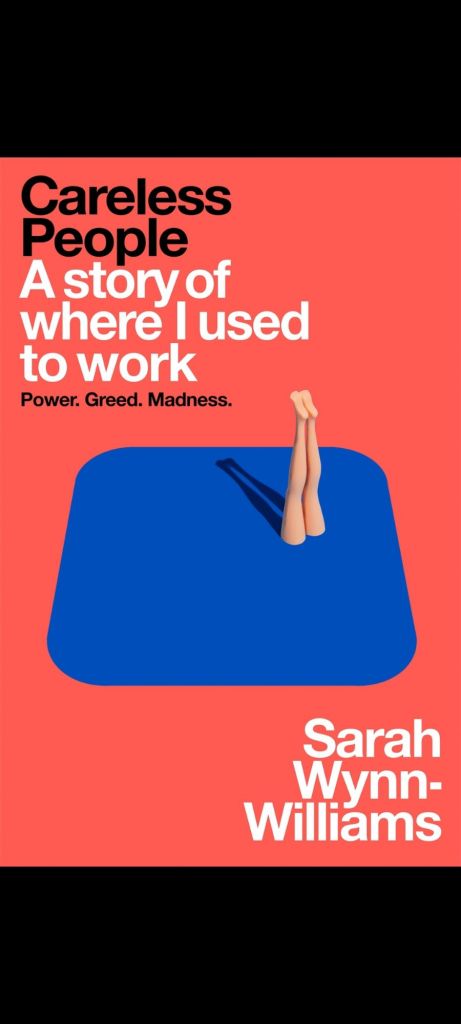
I read Careless People by Sarah Wynn-Williams this week. It’s her memoir of her time in Facebook, ending up as Director of Public Policy. She tells about a time when she was an idealistic young woman, convinced that Facebook could change the world, her year long campaign to be hired in their non-existent policy department and her six years in the business.
It’s a gripping read. Even if you have no interest in business, corporate life, or C-suite and how different companies operate, I’d suggest reading it. Wynn-Williams is a good writer, and a great story teller. Her vignettes from the office are extremely well told.
The bits that stood out to me
OK, a key story that stood out for me, is Wynn-Williams being mid-labour with her first child, emailing the office, to the point where both her partner and her doctor try to take the laptop off her and she refuses until she sends whatever email she was sending.
I have to admit, these kinds of stories are told in Ireland as kind of urban myths and legends from US corporations. But as it turns out – they’re true! (To be fair, this isn’t the first time I’ve had this sort of story confirmed for me)
Another element of motherhood? Wynn-Williams was congratulated by a co-worker for managing to keep very quiet about the fact that she had kids. Seriously – it was considered a good thing that no one in the wider office knew she had kids. What kind of weird place is this???
Another element? She was in Myanmar, no phone, no money, no internet, no way to contact the outside world and was trying to contact the junta. The same folk that are reported to have killed 50,000 people back in 2021… To be fair, this was years after Wynn-Williams’ visit, but y’know. Same crowd. Same approach to life. (And death)
Complete lack of respect for people
No, not the junta, although that’s probably a fair claim as well. But Facebook leadership. Wynn-Williams describes meetings where Facebook employees were expected to go to jail, where hired specifically because they could probably handle going to jail and be ok. Not just in one place, in multiple places.
That’s before we get into the every day acts of control – expecting work to be life. Nothing outside of Facebook. No family, friends, hobbies, etc. We’ve known for years about how the facilities in the Silicon Valley offices are knives that cut both ways, but still, it looks awesome to have everyone you want on the outside.
When it comes to leaving the office, it’s a different story.
Fundamentally, there are repeated stories where C-suite leaders in Facebook do, indeed, appear to occupy a different planet to the rest of us. Private planes, designer bags, getting upset because the Pope refused to make time to meet them… (Yeah actually happened)
Not to mention presidents of countries getting assaulted.
Discussions of who in a meeting is the one chosen to go to jail on a particular issue. How to get senior executives into countries with active arrest warrants for them. Use of employees for personal purposes.
It’s not the first time…
When I read Lean In by Sheryl Sandberg, for the first time – I was impressed. I thought, of course – women need to step forward and not back in the workplace.
But on a reread a few years later, with a few more years under my belt and a bit more experience, I saw the glaring holes in the arguments. It never addressed the looming issues faced by women in high pressure situations, particularly in male dominated spaces.
- Workplace Bias and Stereotyping: Women often encounter explicit and implicit biases and are judged by traditional gender roles. Assertive communication from a woman may be perceived as aggressive, while the same behaviour in a man is seen as strong leadership.
- Hostile Work Environment and Harassment: Women are more likely to experience sexual harassment, microaggressions, and unsupportive or vindictive behaviour from colleagues.
- Social Isolation and Lack of Mentorship: Being a “token” woman can lead to feelings of isolation and a lack of belonging. There are often fewer female role models in senior positions, limiting access to crucial mentorship and networking opportunities that could aid career advancement.
- Pressure to Prove Themselves (Imposter Syndrome): The need to constantly perform at 110% to counter stereotypes and prove their worth can lead to immense pressure, imposter syndrome, and early burnout.
- Mental and Physical Health Impacts: The chronic stress resulting from negative workplace climates and discrimination can dysregulate stress responses (e.g., cortisol levels) and is linked to higher rates of anxiety, depression, and other health issues.
- Career and Pay Disparities: Women often face a “glass ceiling” in leadership roles and experience a persistent pay gap, earning less than their male counterparts for the same work.
- Work-Life Balance Challenges: Inflexible workplace cultures with demanding schedules, combined with societal expectations that women manage primary caregiving responsibilities, exacerbates stress and work-family conflict.
- Undermining of Contributions: Women’s ideas may be ignored or undervalued until a male colleague repeats them, or male managers may take credit for a woman’s work
And that’s just off the top of my head (and a 5 second google search, because I’m not completely reliant on myself!)
Wynn-Williams definitely shows Sandberg in a different light. A very different light. I’ll leave it to readers of the book to discover how bad that turned out to be, but I was shocked by the behaviour described. Sandberg was definitely not a woman’s woman in this book.
Worst of all
Worst of all, this book showed me how even the most intelligent of us can become used to certain ways of working and just… accept them as the norm. Working 16+hr days is not the norm. Have I done it? Of course! I’ve been involved in shutdowns and projects for most of my career, and in those periods of intense activity, it’s all hands on deck.
But when that becomes the norm – then you need to take stock.
I can see Wynn-Williams’ glide into just being subsumed, then trapped by the need for health insurance. And I can’t help thinking that these are the golden handcuffs employers depend on.
While Ireland doesn’t leave you to die without health insurance, certain things are better, quicker, easier and more effective with said health insurance. No one, or very few to be more realistic, in this country is likely to have to choose between life saving drugs and food – a story I am hearing more and more frequently from US based people. However, I know life is better for me, and my husband, with health insurance. And I have made the choice to stay in jobs, just a bit longer, to keep benefits like that going.
I am supremely lucky to not be in that position right now.
What can we learn?
Well, at worst, we can learn the warning signs in the early days of what is likely to be a bad workplace.
- mentioning the work family, or the team is like family
- flexibility being expected always on the part of the employee, never on the part of the employer
- excessive benefits – continual free food is particularly worrying in my opinion
- whispered warnings about particular senior executives, particularly woman to woman
- lack of awareness on behalf of senior staff on the day-to-day of the more junior staff. Or even that junior staff might have, y’know, lives…
- a particular “look” about senior staff. Or in other words, a distinct lack of diversity.
Use this book as a great read, sure, but also use it as a learning tool.
And – from the sounds of it – steer clear of Facebook. Or Meta as we now know it…

 EngineerHer
Leave a comment